
Radiology Practices
How do we help your Radiology Practice?
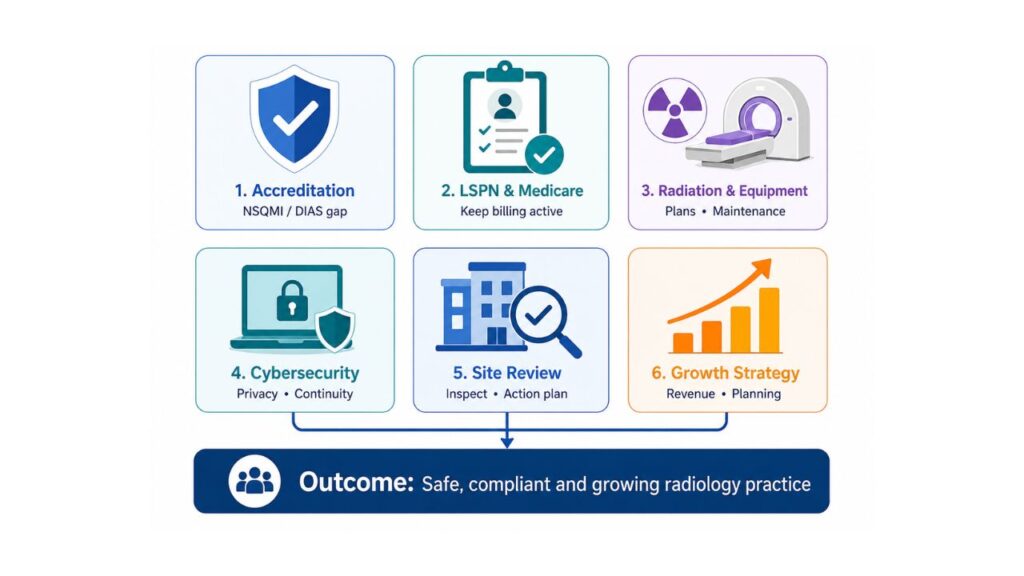
Radiology practices are transitioning to the National Safety and Quality Medical Imaging (NSQMI) Standards. Accreditation is mandatory for practices to continue Medicare billing for eligible procedures. Let us assist you with accreditation using the HBS Clinical Consultancy Pathway™
1. Assess
A comprehensive review of your practice’s current position…
- Assess how you can maintain Medicare billing for eligible procedures
- Gap Analysis new Medical Imaging Std 2026 Draft – National Medical Imaging Standards | Australian Commission on Safety and Quality in Health Care
- Gaps in cyber security and business continuity
- Accuracy of referral and reporting processes
- Analysis of current governance, risk and compliance practices
The initial assessment establishes a clear understanding of the practice alignment with the mandatory standards required to continue Medicare billing.
2. Comply
Comply with legal and regulatory obligations to continue Medicare billing for eligible procedures…
- Radiation Safety requirements for radiology practices – Australian Radiation Protection and Nuclear Safety Agency (ARPANSA)
- Accreditation pathway – Australian Commission on Safety and Quality in Health Care (ACSQHC)
- Compliance with the Medicare billing requirements
- Cybersecurity and processes for information management
- Contract management
When your radiology practice’s is compliant with legal, regulatory and clinical standards, the practice can continue to bill Medicare for eligible procedures.
3. Design + Implement
Co-design solutions and implement an action plan
- Business and clinical governance and reporting
- Information security for patients and referrers
- Business continuity and disaster management plans
- Leadership coaching and clinical team support
- Clinical procedures updated
- Skills competency planning for admin and clinical staff
A radiology practice specific action plan is developed to ensure your radiology practice is ready for mandatory audits that are required to bill Medicare for eligible procedures.
4. Advisory
Provide ongoing advisory and continuous improvement services…
- Assistance with unannounced audit visits and clinic inspections
- Quarterly advisory services updating you on changes in radiology accreditation and legislative changes
- Risk and compliance monitoring
- Strategic planning refresh
- Support for new services, expansions or leadership changes
Keeping radiology pratices abreast of any changes, let’s you focus on service provision and strategic goals.
Radiology Practice Frequently Asked Questions FAQs
How do radiology practices apply for licensing with each state or territory's Department of Health in Australia?
Each radiology practice needs to complete a formal application and submit it to the relevant state or territory Department of Health and this must be completed before commencing any radiology services. HBS assists with applications to state/territory Dept’ of Health in all parts/jurisdictions of Australia.
How do you apply for a Location Specific Practice Number (LSPN) so that the radiology practice can bill Medicare?
Prior to commencing radiology services, a new site or clinic must apply for a Location Specific Practice Number (LSPN) and this is required for each radiology practice site or clinic. Health Business Solutions can apply for and maintain the currency of your LSPN on your behalf.
What happens if any of the radiology services change within a radiology practice?
If any of the services within the radiology practice change, the relevant state or territory Department of Health must be notified immediately and directly.
What is required to maintain billing to Medicare for a radiology practice?
To maintain billing to Medicare, the radiology practice must be formally accredited via an independent review conducted by an independent accrediting agency.
What is the current accreditation scheme in Australia for a radiology practice?
Radiology services are transitioning from the Diagnostic Imaging Accreditation Scheme (DIAS) Standard to the National Safety and Quality Medical Imaging (NSQMI) Standards. An audit is conducted to check compliance against the standards, and the audit includes a mandatory practice clinic inspection conducted by an auditor from an independent accrediting agency.
Who are the independent accreditation agencies that can provide an accreditation audit for a radiology practice?
The current independent accreditation agencies that can provide an audit for a radiology practice include: IHDAA Australia Pty Ltd, National Association for Testing Authorities and Quality Innovation Performance QIP Ltd. Health Business Solutions can help your practice select the most relevant agency for your radiology practice.
What is included in an application to an independent accreditation agency for an accreditation audit for a radiology practice?
The application to an independent accreditation agency includes the size and scope of the radiology practice. The independent accrediting agency will conduct an assessment against the Diagnostic Imaging Accreditation Scheme (DIAS) Standard – that future accreditations will be against the National Safety and Quality Medical Imaging (NSQMI) Standards. Health Business Solutions can help your radiology practice prepare the application to the independent accreditation agencies that are selected by the Australian Commission for Safety and Quality in Healthcare.
What are the mandatory requirements for the National Safety and Quality Medical Imaging Standards Accreditation in Australia?
A mandatory requirement for the National Safety and Quality Medical Imaging Standards Accreditation Scheme is that clinic inspection carried out in person by the auditor. The audit practice inspection reviews how clinical and operational processes are implemented.
How is radiation usage regulated in Australia?
Radiation usage is regulated in Australia by the Australian Radiation Protection and Nuclear Safety Agency (ARPANSA).
Where are Radiation Management Plans (in accordance with ARPANSA guidelines) submitted?
Radiation Management Plans must be submitted to the relevant state or territory agency and be in accordance with ARPANSA guidelines. The agency will then confirm the radiation usage guides. In Victoria and Queensland, the Department of Health monitors radiation safety, but in New South Wales and South Australia it is the Environmental Protection Agency EPA and Western Australia uses the Radiological Council of WA. Health Business Solutions can ensure your radiology practice submits the relevant Radiation Management Plans correctly.
What should be included in a Radiation Management Plan?
A Radiation Management Plan is a mandatory document that outlines how a radiology practice:
- identifies radiation hazards
- manages risks
- implements safety measures
- protects people and the environment when using radiation sources
It must also include hazard identification, risk controls, staff training, equipment details, incident response procedures, and compliance with relevant regulations.
Health Business Solutions can help prepare your Radiation Management Plan and ensure that it is written specifically for each individual radiology practice.
Health Business Solutions can also ensure that the Radiation Management Plan is reviewed by a medical physicist.
What happens after an independent accreditation audit is completed?
After the mandatory accreditation audit is completed, there may be unannounced audit visits, so it is essential to maintain the systems within your radiology practice.
How often are accreditation audits completed?
Accreditation audits for radiology practices are scheduled mid cycle every eighteen months and re-certification audits occur every three years.
Do we need an radiation management plan
Would you like us to help you?
We welcome an initial complimentary discussion to discuss how we can assist you or you can request a quote…