
Fertility + Assistive Reproductive Technology Providers
How do we help your Fertility + ART service with accreditation?
There are new mandatory standards for all fertility service providers. Let HBS help you prepare the accreditation audit using our Clinical Consultancy Pathway™
1. Assess
A comprehensive review of your clinic’s current position…
- Gap analysis against mandatory accreditation standards for fertility, ART + IVF services.
- Assess laboratory and embryology services against standard for medical lab’s – ISO15189:2022
- Understand legal requirements for state/territories where you provide fertility services
- Analysis of current governance, risk and compliance practices in your business
- Review alignment of clinical practice against evidence-based guidelines as required for mandatory accreditation.
The purpose of the initial assessment is to establish a clear understanding of the practice alignment with the mandatory standards.
2. Comply
Understand governance, risk and legislative compliance requirements.
- Avoid legal issues and court cases
- Understand the accreditation pathway for fertility services– Australian Commission on Safety and Quality in Health Care (ACSQHC)
- Comply of laboratory work processes for medical laboratories and safe work practices
- Improve cybersecurity systems to protect information and prevent data breaches
- Optimise suppliers and contract management processes to improve outsourced services
Compliance with laws relating to fertility service and clinical regulatory standards is a mandatory requirement for all fertility services.
3. Design + Implement
Co-design tailored solutions and implement the action plan to meet mandatory standards. The tools and processes we provide include
- Strategic plans for growth – detailed action focused plans specific to your location and service delivery model.
- Cyber security controls and protocols aligned to operational software you use
- Data driven decision making – business and clinical governance and reporting
- Process maps for medication safety, patient deterioration and clinical emergency pathways
- Laboratory procedures written to meet ISO 15189 requirements
- Equipment calibration and maintenance schedules
- Business continuity and disaster recovery procedures
Grow and expand your fertility services with business and clinical management systems designed specifically for fertility services. Get clinic specific action plans to ensure your fertility service is ready for accreditation audits.
4. Advisory
Provide ongoing advisory and continuous improvement services…
- Assistance with unannounced audit visits
- Quarterly advisory services updating you on legislative changes
- Risk and compliance monitoring
- Strategic planning refresh
- Support for new services, expansions or leadership changes
We keep you up to date with changes so that you can focus on your service provision and strategic goals.
Fertility Services and ART Frequently Asked Questions FAQs
What is the purpose of this FAQ ?
.This FAQ is designed for fertility clinics, IVF laboratories, clinical directors, embryologists, nurses and practice managers. It addresses the regulatory, accreditation, clinical governance and patient safety requirements for fertility services in Australia, including the transition to new national safety and quality standards for assisted reprodutive technology.
How do fertility services apply for accreditation
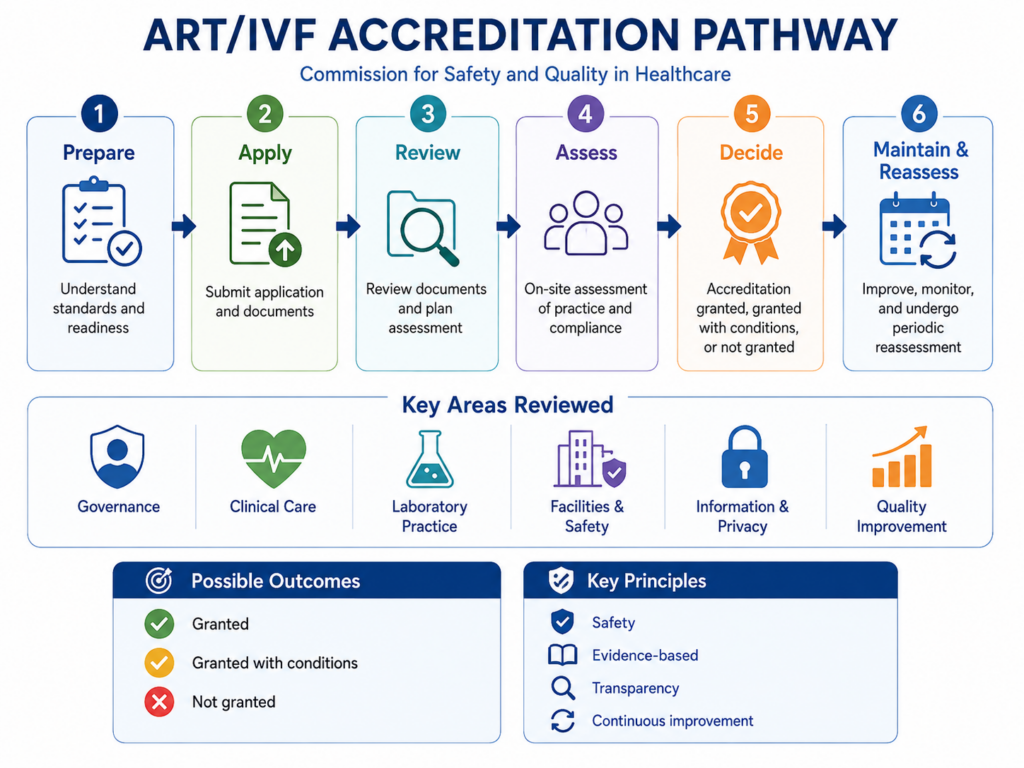
Prior to commencing services a new site or clinic must apply to accreditation agency approved by the Australian Commission for Safety and Quality in Healthcare. Health Business Solutions assists fertility services with the application.
Existing proviers will have to go through the same process of applying to the auditing agency to get the accreditation audit set up.
Will RTAC standards be replaced?
The national scheme will replace the existing RTAC accreditation arrangements following a managed transition. Until the new scheme becomes operational, RTAC continues to manage accreditation, including certification and annual surveillance audits. Clinics should therefore maintain existing accreditation while preparing for the new requirements.
What should fertility providers do now to prepare for the new mandatory standards to maintain billing to Medicare for a radiology practice?
Fertility services providers should undertake a structured readiness assessment addressing clinical governance, laboratory quality management, patient identification, consent, incident management, workforce competency and regulatory compliance. A practical approach involves comparing existing systems against the draft standards, identifying gaps, prioritising high-risk issues, allocating responsibilities and establishing an improvement plan. Clinics should monitor the Commission’s publications because requirements may change before the standards are finalised.
What ISO standards apply to fertility servies including embryology services ?
International standard ISO 15189 Medical laboratories for quality and competence are applicable dependent on the laboratory’s services and accreditation scope. The mandatory ART standards specify that the laboratory must comply with the ISO standard an be a NATA approved laboratory. Providers should distinguish voluntary quality improvement approaches from mandatory ART accreditation and licensing obligations.
Who are the independent accreditation agencies that can provide an accreditation audit for a fertility services and assisted reprodutive technology and IVF?
The current independent accreditation agencies that can provide an audit for fertility serivces the existing accreditation agencies include: IHDAA Australia Pty Ltd, National Association for Testing Authorities NATA and Quality Innovation Performance QIP Ltd. Health Business Solutions can help your practice select the most relevant agency for your radiology practice.
What is included in an application to an independent accreditation agency for an accreditation audit for a fertility clinic?
The application must give information about the size and scope of the business and the range of services. Information on laboratory and embryology services must also be provided. If any parts of the service are outsourced to other clinics or laboratories that information must also be given.
How can fertility clinics reduce the risk of embryo or gamete identification errors?
A mandatory requirement for the National Safety and Quality Assisted Reproductive Technology Service Standards is that identification systems should operate throughout the reproductive material’s lifecycle, from collection and processing through storage, transfer, donation and disposal. Controls may include electronic witnessing, barcode or RFID systems, independent verification at critical steps, secure labelling and traceable electronic records. Technology should complement, rather than replace, validated procedures, staff competency and effective clinical supervision.
What are the governance processes required for fertility services ?
Clinical governance is the system through which directors, managers and clinical leaders are accountable for maintaining and improving the safety, quality and effectiveness of care. An effective framework includes defined responsibilities, credentialling and scope of practice, risk management, incident review, consumer feedback, clinical audit, performance monitoring and continuous improvement.
Data governance and cybersecurity are very important for fertility services as well as business continuity and disaster recovery plans
What laboratory and embryology management processes are required?
A laboratory quality management system should provide effective control over:
Standard operating procedures and document management.
Specimen identification, witnessing and traceability.
Equipment qualification, calibration and maintenance.
Environmental monitoring and laboratory conditions.
Staff training, authorisation and competency assessment.
Internal audits, nonconformities and corrective actions.
Emergency preparedness and business continuity.
Performance indicators and management review.
These systems should generate reliable evidence that laboratory processes are controlled and consistently followed.
How should risk and cybersecurity be managed?
Fertility services hold highly sensitive information, including health records, genetic information, donor details and reproductive treatment histories.
Important controls include multifactor authentication, role-based access, encryption, secure backups, vulnerability management, penetration testing, system monitoring and tested disaster recovery arrangements.
Clinics should also maintain a data breach response plan and assess cybersecurity risks associated with third-party laboratories, cloud providers and technology vendors
What happens after an independent accreditation audit is completed?
After an independent accreditation audit is completed, there may be unannounced audit visits, so it is essential to maintain the systems within the fertility service and assisted reproductive technology provider.
How often are accreditation audits completed?
Accreditation audits for radiology practices are scheduled mid cycle every eighteen months and re-certification audits occur every three years.
What must the embryology lab do to comply with the ISO standard
What must the embryology lab do to comply with the ISO standard
Would you like us to help you?
We welcome an initial complimentary discussion to discuss how we can assist you or you can request a quote…